en
Merck Electronics and FLEXCELERATE Solutions now validate recipes for modular process plants in advance, using a digital twin of the plant. The approach works across vendors and is based on open standards (FMI, MTP, OPC UA). Faulty runs are caught before they cost material and plant time.
In process development in Merck's Electronics division, many recipe variants are created before a process runs optimally. They are executed on a modular plant. If an error slips through the initial checks during an adjustment, the input materials are lost, rework is required, and the plant is blocked during that time; per run, this quickly adds up to tens of thousands of euros. Until now, a modified recipe could only be fully validated on the real plant.
Together with FLEXCELERATE Solutions, a virtual test bench was built. Recipes are validated against a digital twin of the plant, so the next recipe can already be run virtually while a trial is still running on the real plant. The batch and orchestration system remains the same and controls virtual controllers (PLCSim Advanced, zenon Logic) connected to simulation models. The test bench is built entirely on open standards: FMI for the simulation models, MTP for modular automation, and OPC UA for signal exchange between automation and simulation. This allows the control system, virtual controllers, and simulation models from different vendors to be combined, without committing to a single provider. FLEXCELERATE Preflight handles connecting the models and running the simulation.
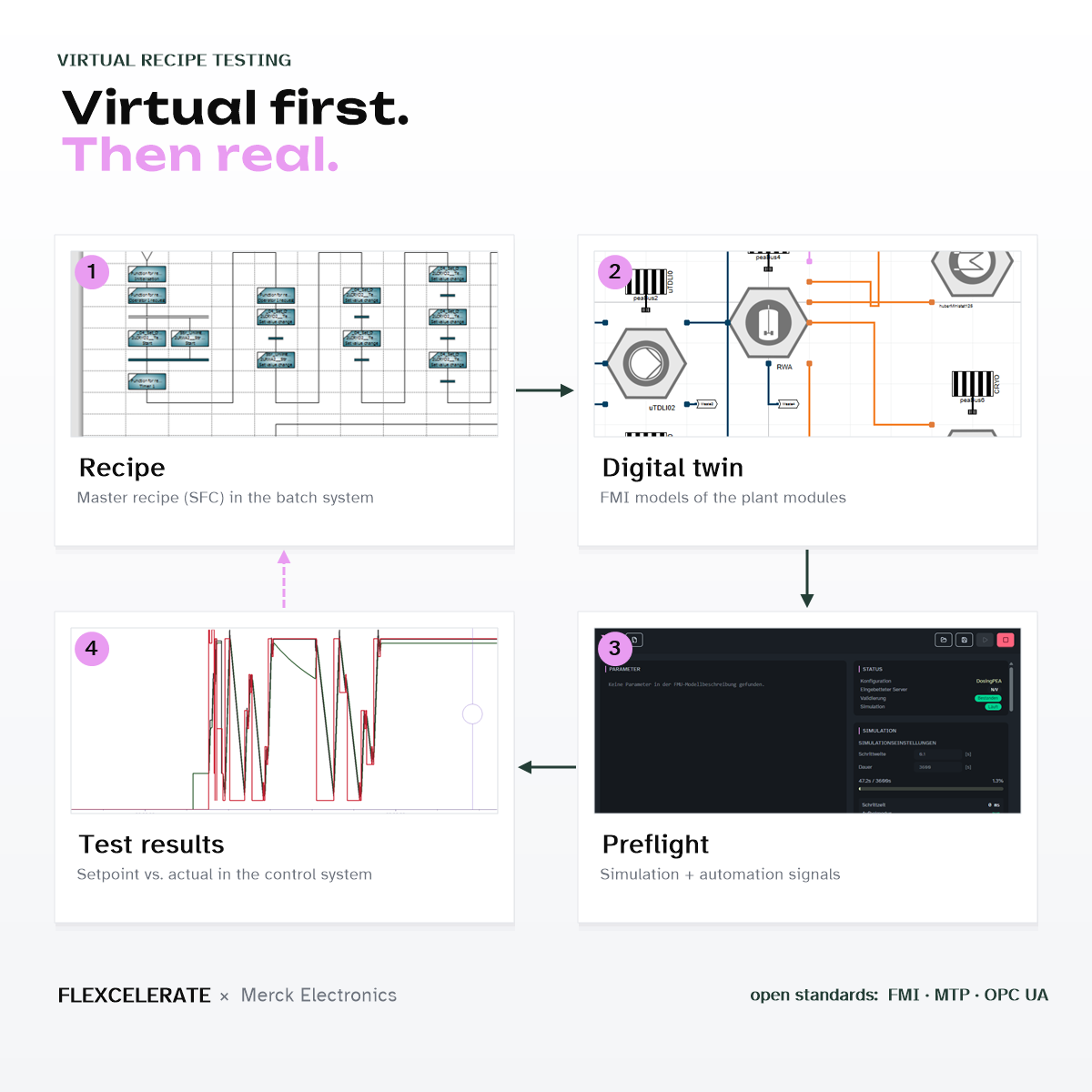
Recipe errors now show up during simulation, before material and plant time are committed. Because the next recipe can be tested in parallel with ongoing trials, development cycles are shorter. Once created, module models can be reused for further plant configurations, preserving the flexibility of the modular plant.
Because the test bench is built on open standards, it can be extended to further modules and plants. In addition, plant operators could be trained for operating flexible, modular plants with the help of the simulation.
"We can test recipe changes virtually before they go to the plant, and we're not tied to a single vendor. That gives us more confidence with every change."

"For me, this is a real relief. I test a recipe virtually first, before it runs on the plant. And I can try things out and learn as I go, without risking material or plant time."